
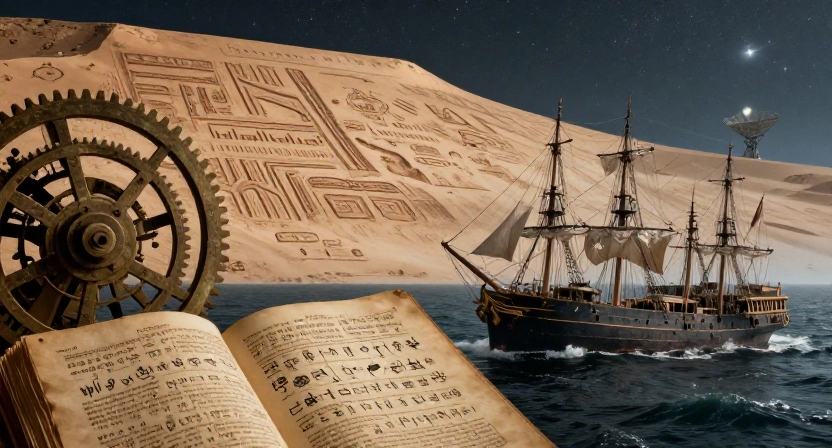
1. The Voynich Manuscript: A Book Nobody Can Reliably Read
Few historical objects look as if they were designed specifically to frustrate future scholars. The Voynich Manuscript, located at Yale University's Beinecke Rare Book and Manuscript Library, features pages of unknown script accompanied by illustrations of plants, celestial or astrological charts, figures in water, pharmaceutical-like substances, and various odd visuals. Yale says the manuscript was produced in Central Europe around the late 15th or 16th century, while scientific testing is consistent with materials from the 15th century. The central mystery is the text. Its script has not been convincingly identified or deciphered. That has produced competing possibilities. The text could symbolize an actual language, depict a created language, employ a unique code, or fulfill another role that contemporary readers haven't identified. It is also possible that parts of the manuscript are nonsensical, though its complexity complicates the establishment of simple explanations. Assertions of effective decoding surface from time to time, but a true resolution would require a systematic explanation of the manuscript rather than merely translating a handful of conveniently chosen words. Until a method can be independently applied across the text, the Voynich Manuscript remains undeciphered.
2. The Lost Colony of Roanoke: Where Did the Colonists Go?
In 1587, an English colony was established on Roanoke Island, in what is now North Carolina. The settlement struggled with food insecurity and worsening relations with Indigenous communities. Governor John White sailed back to England for supplies, expecting to return. War with Spain delayed him. White did not make it back to Roanoke until 1590. By then, the colonists were gone. The story is sometimes presented as though an entire community simply vanished without leaving a clue. The reality is more complicated. Before White departed, the colonists had discussed relocating, and the National Park Service notes that they planned to leave a message indicating their destination if they moved. The famous clue was "CROATOAN," associated with the nearby Croatoan community and island. That makes relocation or integration with Indigenous communities considerably more plausible than supernatural disappearance. Other possibilities include movement elsewhere, conflict, disease, starvation, or some combination of events. The persistent issue is not a complete lack of explanations. It is the absence of enough conclusive evidence to reconstruct exactly what happened to the colonists after White left.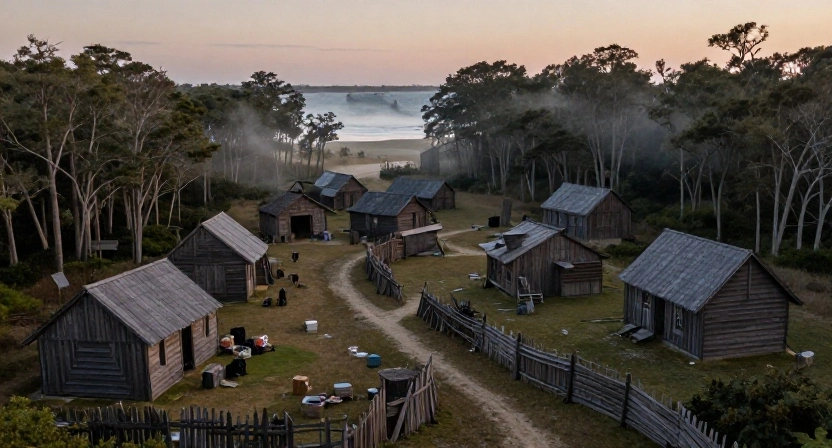
3. The Mary Celeste: Why Was a Seaworthy Ship Abandoned?
On December 4, 1872, the crew of the Dei Gratia encountered the Mary Celeste drifting in the Atlantic near the Azores. The vessel departed from New York with 1,701 barrels of industrial alcohol heading to Genoa. There were ten individuals on board: Captain Benjamin Briggs, his wife and their young daughter, along with seven crew members. When the vessel was discovered, all ten were missing. The lifeboat was also gone. The ship itself had not been destroyed. That detail helped transform the Mary Celeste into one of maritime history's most famous mysteries. Famous adaptations included pirates, rebellion, mythical creatures, and supernatural elements, yet the data does not necessitate any of these. A more practical question is why an experienced captain might have believed temporarily abandoning the vessel was safer than remaining aboard. Weather, concerns about the alcohol cargo, inaccurate estimates of the ship's condition, navigation problems, or several factors acting together have all been considered. If Briggs ordered everyone into the lifeboat and the small boat subsequently became separated from the ship, an emergency evacuation could have turned fatal very quickly. The individuals who went missing were never located, leaving the ultimate series of events a mystery.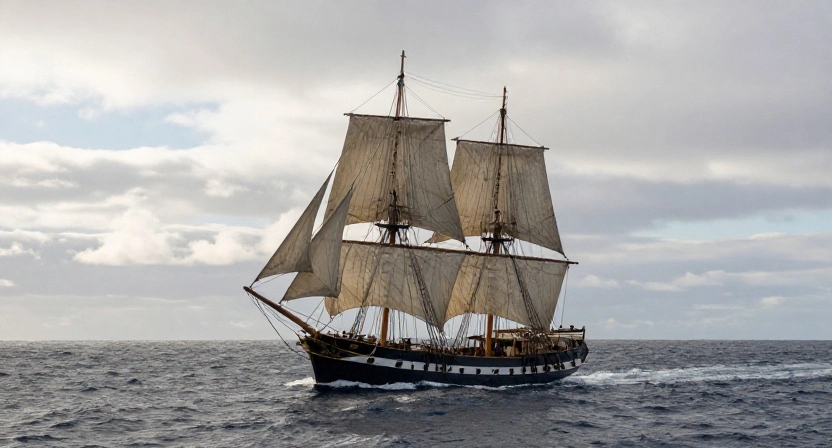
4. The Nazca Lines: We Know Who Made Them Better Than Why
Across the dry coastal landscape of southern Peru are enormous geoglyphs depicting animals, plants, geometric forms, straight lines, and other designs. UNESCO dates the creation of the Nazca and Palpa geoglyphs broadly between about 500 B.C. and A.D. 500 and describes them as a remarkable cultural landscape created by pre-Hispanic societies. Their construction is not technologically inexplicable. People could create visible designs by removing darker surface material and exposing lighter ground underneath. There is also no convincing reason to support the widespread assertion that extraterrestrial beings were responsible for their creation. Their precise meaning is harder to establish. Ritual practices play a significant role in the interpretation of archaeological findings. Some lines may have functioned as pathways used in ceremonies, while aspects of the landscape could have carried religious or social significance. UNESCO also notes proposed ritual and astronomical functions. One difficulty is assuming that thousands of markings created over long periods must all have served a single purpose. Various shapes and lines might have been created for distinct purposes. The mystery, therefore, is not "How could ancient people possibly make these?" It highlights the importance of the designs to the communities that created and employed them.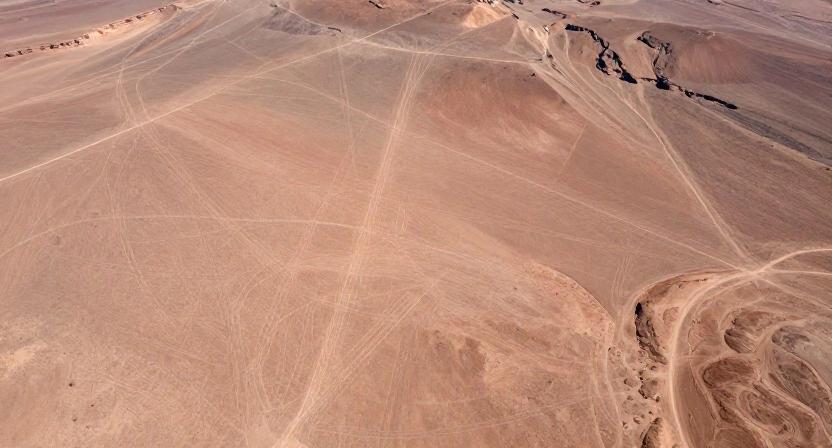
5. The Antikythera Mechanism: Ancient Innovation Beyond Anticipations
In a shipwreck near the Greek island of Antikythera, divers recovered corroded fragments of what turned out to be an extraordinary geared mechanism. Studies employing advanced imaging techniques have revealed that the Antikythera Mechanism was an astronomical calculating instrument from ancient Greece constructed circa the second century B.C. Its intricate bronze gears represented astronomical cycles, including information involving the Sun and Moon, calendars, and eclipses. Evidence from inscriptions also points toward displays involving the known planets. That much is remarkable but increasingly well understood. The remaining mystery concerns the complete machine. Only part of the original mechanism survives. Researchers therefore have to reconstruct missing components from fragments, inscriptions, mathematical relationships, and what is known about ancient Greek astronomy. A 2021 reconstruction proposed a model for the front display while explicitly acknowledging that lost evidence prevents researchers from claiming it is an exact replica of the original. Questions also remain about the mechanism's precise origin, context, designer, and how widely such engineering knowledge was shared. Its significance lies less in being "impossible" ancient technology and more in showing that ancient mechanical engineering was capable of sophistication that surviving evidence rarely preserves.6. The Dyatlov Pass Incident: A Mystery With a Stronger Scientific Explanation
In February 1959, nine experienced hikers died during an expedition in the northern Ural Mountains of the Soviet Union. The circumstances surrounding their deaths produced decades of speculation. One major question was why members of the group apparently left or escaped from their tent under extremely dangerous winter conditions. Theories grew increasingly exotic, ranging from secret weapons to unexplained phenomena. A research study released in Communications Earth & Environment in 2021 suggested that a postponed slab avalanche might be physically possible given the unique conditions at the campsite. The researchers modeled how the accumulation of snow and the change in the slope by the team could have triggered a slab release. This does not imply that every aspect of the event has been reconstructed without any disagreement. It does, however, illustrate an important distinction. A mystery can possess a compelling natural rationale even if investigators are unable to reconstruct every second of the occurrence. Dyatlov Pass is therefore less mysterious than many popular versions suggest, but uncertainty about the exact sequence of decisions, injuries, and movements that night continues to fuel discussion.7. The Wow! Signal: 72 Seconds That Never Repeated
On August 15, 1977, the Big Ear radio telescope at Ohio State University picked up a remarkably powerful narrowband radio signal while searching for extraterrestrial intelligence. Astronomer Jerry Ehman famously wrote "Wow!" upon the computer output, giving the event a permanent name. The signal gained notoriety partly due to its traits that rendered it intriguing within SETI investigations. The essential issue is straightforward: it was never found again. The SETI Institute emphasizes that repeatability is essential before a signal can credibly be regarded as evidence of extraterrestrial technology. The Wow! Signal, despite its reputation, has never met that standard. Over the years, researchers have suggested both natural and human-made explanations, yet none have gained universal approval. That leaves the Wow! Signal in an unusual category. There is no proof that extraterrestrials reached out to Earth, yet the origin of this information has not been definitively traced either. Its mystery survives in a tiny amount of data from an event that could not be reproduced.
8. The Bermuda Triangle: A Mystery That May Mostly Be a Myth
The Bermuda Triangle deserves a place in a discussion of famous mysteries for a different reason: it demonstrates how storytelling can become more mysterious than the underlying evidence. The loosely defined region of the western North Atlantic has been associated with disappearances of ships and aircraft for decades. Explanations have included everything from magnetic anomalies to Atlantis and extraterrestrials. NOAA offers a much less dramatic assessment. The agency observes that tropical storms and hurricanes influence the area, the Gulf Stream can lead to swift shifts in conditions, and shallow waters near Caribbean islands may pose navigation risks. More importantly, NOAA states that there is no evidence that mysterious disappearances happen more frequently there than in other large, heavily traveled ocean regions. There is not even an officially recognized geographic boundary for the "Triangle." Individual maritime and aviation accidents can certainly contain unanswered questions. That is different from demonstrating that the entire region possesses a mysterious force. The Bermuda Triangle might be one of the top examples of a cultural enigma formed by merging actual disasters, partial facts, biased accounts, and years of exaggerated conjecture.The Largest Mystery May Be Why Some Mysteries Never Die
These cases do not all belong in the same category. The Voynich Manuscript contains real information that remains inaccessible because its writing has not been deciphered. Roanoke and the Mary Celeste pertain to historical occurrences where essential evidence has vanished. The Nazca Lines raise queries about their cultural significance. The Antikythera Mechanism survives only partially. The Wow! Signal was recorded but never repeated. Dyatlov Pass has become more scientifically explainable, while the Bermuda Triangle looks much less mysterious once its broader context is examined. That distinction matters. A mystery is not automatically proof of something extraordinary. "We are not certain about what took place" and "there is no typical rationale" are entirely distinct assertions. Missing evidence is often enough to preserve uncertainty indefinitely. Once the people involved are dead, archaeological material has deteriorated, documents have disappeared, or an observation cannot be repeated, there may simply be no experiment capable of producing a final answer.What Separates a Real Mystery From a Good Story?
The greatest difficulty when studying renowned mysterious occurrences is resisting the urge to give equal weight to every theory.An effective method to evaluate a mystery is to inquire:
- What physical or documentary evidence actually survives?
- Which information originates from current documentation, and which emerged in subsequent narratives?
- Can the proposed explanation be tested?
- Does it require assumptions unsupported by the evidence?
- Have newer archaeological, historical, or scientific methods changed the case?
- Does "unexplained" simply mean that some information is permanently missing?
Reasons the World's Largest Mysteries Remain Significant
Human beings are uncomfortable with unfinished stories. We are curious about what transpired following the last entry in a ship's log, what an unidentified writer penned ages ago, and why individuals etched colossal patterns into a barren terrain. But uncertainty is not a failure of knowledge. Sometimes it marks the boundary between evidence and imagination. The most persistent enigmas exist at that threshold. Modern technology may reveal hidden writing, reconstruct ancient machines, or demonstrate that an old theory is physically possible, but it cannot always recover evidence that history has erased. That is why the biggest mysteries of the world remain compelling. Their worth is not only that they don't provide answers. They demonstrate how historians and scientists create explanations from partial evidence, and why a cautious "we still don't know" can be more significant than an impressive answer lacking factual support.Sources Consulted
- Yale Beinecke Library: Voynich Manuscript
- U.S. National Park Service: The Lost Colony of Roanoke
- NOAA: What Is the Bermuda Triangle?
- UNESCO: Lines and Geoglyphs of Nasca and Palpa
- Nature: Decoding the Antikythera Mechanism
- Communications Earth & Environment: Dyatlov Pass Avalanche Study
- SETI Institute: SETI FAQ and the Wow! Signal
- Smithsonian Magazine: The Mary Celeste Mystery