

The First Important Distinction: Forgetting a Dream Is Not the Same as Not Dreaming
The most common assumption is that people who rarely remember dreams simply do not dream very often. Research does not support that straightforward conclusion. Dreaming can occur during both REM (rapid eye movement) and non-REM sleep. REM sleep is strongly associated with vivid, story-like dreams, but dream experiences have also been documented during non-REM stages. This matters because waking up without a remembered dream does not tell you whether no dream occurred. It may simply mean that the experience was never successfully encoded into a memory that could be retrieved after waking. Think about the difference between seeing a movie and writing down a detailed account of it afterward. Experiencing something does not guarantee that you will retain a usable record of it. Dreams have a similar problem. The brain can generate a complex experience without necessarily creating a durable memory of that experience.
Why Dream Memories Disappear So Quickly
One of the strongest explanations is surprisingly simple: the memory of a dream may be fragile from the moment you wake up. Researchers studying dream recall have found that the time between awakening and reporting a dream matters. Dream details can disappear rapidly if they are not retrieved or recorded immediately. Reviews of dream research recommend minimizing the delay between waking and reporting precisely because memory loss and reconstruction can occur during that interval. Imagine waking from a dream in which you are standing inside an unfamiliar airport. You remember a red suitcase, your old high school friend, and a strange announcement over the speakers. Then you think, "I need to get ready for work." Your attention shifts. You check the weather. You answer a text. Your thoughts turn to traffic. Five minutes later, the red suitcase may be gone. Ten minutes later, even the airport may be gone. That does not necessarily mean the dream was erased like a computer file. Instead, its memory may never have been stabilized strongly enough to survive interference from everything that happens after waking.Waking up at the right moment matters
People who experience more awakenings during the night tend to report more dreams. Research has found that differences in dream recall between people can be associated with differences in nighttime awakenings, including awakenings from non-REM stage 2 sleep. This helps explain an everyday mystery: someone who says, "I never dream," may actually be having plenty of dreams but rarely waking at moments when those experiences can be transferred into waking memory. In other words, dream recall depends partly on the bridge between sleep and wakefulness.
REM Sleep Gets the Credit, but the Story Is More Complicated
REM sleep has a special place in discussions about dreams because it is associated with vivid mental experiences, rapid eye movements, and distinctive patterns of brain activity. Additionally, REM periods lengthen as the nite goes on. That creates an interesting practical effect. If you sleep seven or eight hours, you spend more of the latter portion of the night in REM sleep. If you wake naturally in the morning, you may therefore be waking closer to a vivid dream experience than you would after an earlier awakening. But it would be misleading to say that all dreams happen during REM or that REM alone determines whether you remember them. Studies have found dream experiences in non-REM sleep as well, and some research on dream recall has found an important role for awakenings from non-REM sleep. The better picture is that dreaming and dream recall are related but separate processes. Your brain can produce a dream. Then, separately, it has to preserve enough information about that experience for your waking brain to retrieve it. Those two things do not always happen together.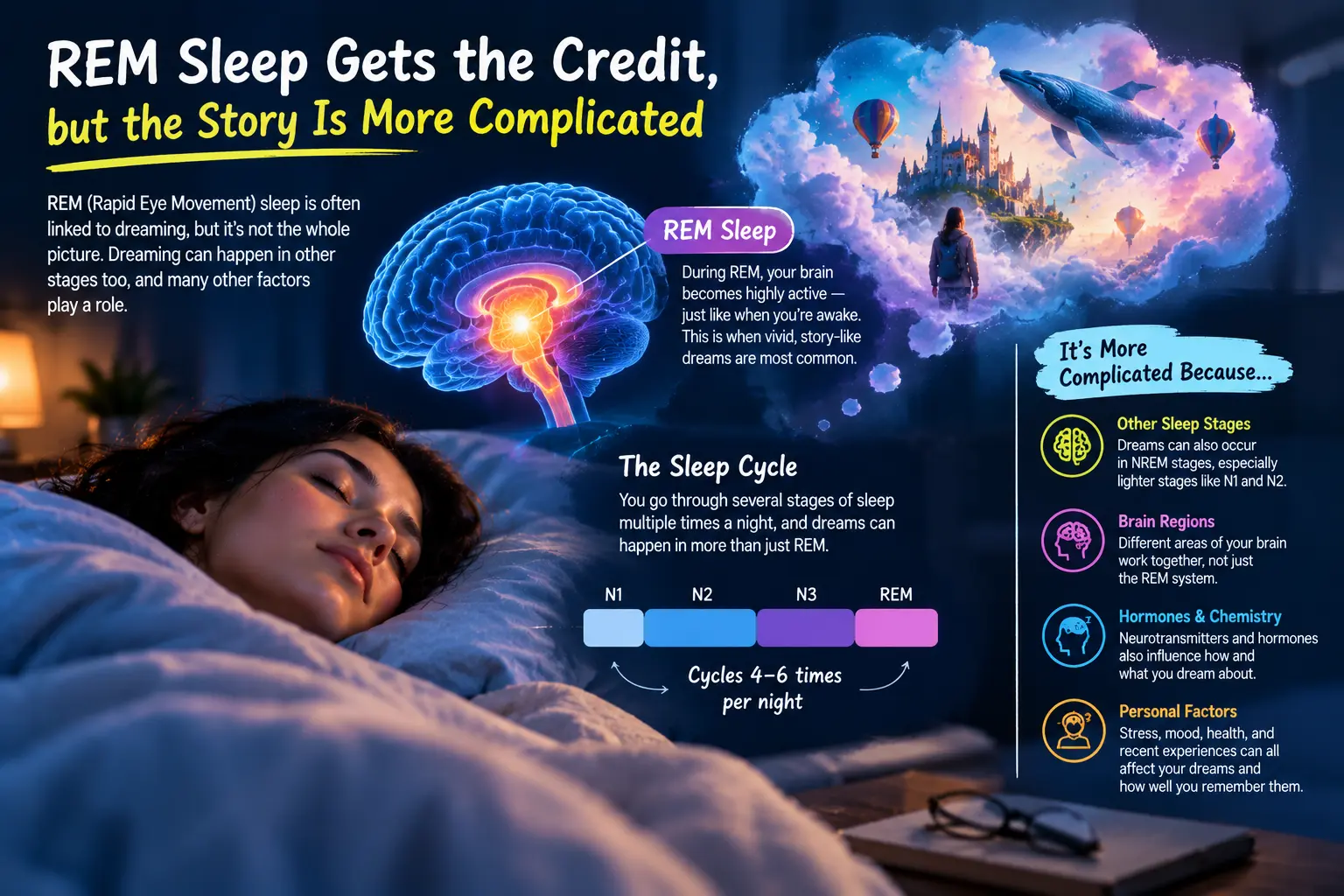
Your Brain May Not Be Trying to Save the Dream
One of the more intriguing possibilities is that the brain's sleep state may actually favor forgetting. A 2019 study funded by the National Institutes of Health examined specific neurons in mice that were active during REM sleep. Researchers found that manipulating these neurons affected the animals' ability to retain certain newly learned information. The findings suggested that particular cells may contribute to active forgetting during REM sleep. [original research] There is an important qualification here: this was research in mice, not proof that the human brain deliberately erases dreams. Still, the finding fits into a larger scientific question about why forgetting exists in the first place. The brain is constantly receiving information. If every detail were preserved equally, memory would become less useful, not more. Forgetting helps the brain avoid treating every passing experience as equally important. Dreams are unusual because they can combine fragments of recent experiences, older memories, emotions, expectations, and imagined situations. Research has found that dream content can incorporate memories from waking life, sometimes drawing on recent experiences and sometimes on much older information. From that perspective, failing to preserve every dream in long-term memory may not be a malfunction. It could partly reflect the brain's normal way of managing information during sleep. Scientists do not yet know whether dream forgetting itself serves a specific adaptive purpose in humans. The evidence is interesting, but the idea should be treated as a developing hypothesis rather than a settled explanation.Dream Memory Has a Difficult Encoding Problem
There is another way to understand dream forgetting: the brain may have trouble encoding a dream as a conventional autobiographical memory in the first place. During ordinary waking life, memory formation occurs in a state in which we are receiving continuous sensory information and actively orienting ourselves in the environment. We know where we are, what just happened, and what we are doing next. A dream does not necessarily provide that same framework. You might be in your childhood home, then suddenly in a city you've never visited, talking to a coworker who looks completely different from reality. The dream may feel coherent while you are experiencing it, but its events do not necessarily follow the ordinary rules that help organize waking memories. Researchers have found that successful dream recall is associated with particular patterns of brain activity immediately before awakening. For example, studies have identified differences in EEG activity associated with whether people subsequently recall dreams after awakening from REM or certain non-REM stages. This suggests that dream recall is not simply a matter of having a vivid dream. The brain's state around the moment of awakening also appears to influence whether the experience becomes accessible to conscious memory.Why Some People Remember Dreams More Than Others
Dream recall varies considerably from person to person. Some people routinely remember several dreams. Others may go weeks without recalling one. Research has linked these differences to several factors, including nighttime awakenings, sleep patterns, attitudes toward dreaming, and certain individual psychological characteristics. Interest itself may play a role. If you wake up every morning and immediately think, "What did I dream?", you are giving dream memory attention that another person may never give it. Keeping a dream journal can also increase reported dream recall, although researchers caution that the relationship can work in both directions: people interested in dreams may be more likely to keep journals in the first place. Age and sleep patterns can matter too. Recent research suggests that dream recall is influenced by a combination of individual characteristics and overnight sleep behavior rather than one simple biological switch. So if your friend remembers elaborate dreams every morning and you remember almost none, that does not necessarily mean your friend dreams more. They may simply be better at catching the memory before it disappears.Why Nightmares Are Often Easier to Remember
There is a useful clue hiding in the fact that unpleasant dreams often seem easier to recall. Strong emotional experiences generally receive more attention than ordinary ones, and nightmares can produce an abrupt awakening. That combination creates a better opportunity for the dream to enter waking memory. Research has found an association between nightmare frequency and dream recall frequency. This does not mean every remembered dream is emotionally intense, or that emotional dreams are always better remembered, but it helps explain why someone might remember a frightening dream from last night while forgetting several ordinary ones. There is also a practical reason: if a nightmare wakes you suddenly, you may spend several moments thinking about what just happened. That extra attention gives the memory a chance to stick.Does Waking Up Naturally Help You Remember Dreams?
It can, but the bigger issue is what happens immediately afterward. Abrupt awakenings can favor dream recall compared with gradual awakening, and research guidance emphasizes reporting the dream as soon as possible after waking. This is why the classic advice to keep a notebook or voice recorder beside the bed has some scientific logic behind it. The goal is not to make dreams more vivid. It is to capture the memory before waking-life information interferes with it. If you want to experiment with better dream recall, try this simple routine:- Stay still for a few moments after waking. Before reaching for your phone, ask yourself what you were just experiencing.
- Capture fragments immediately. A few words such as "airport, red suitcase, brother, rain" can be enough.
- Use a voice memo if writing feels too slow. The important thing is minimizing the delay.
- Record feelings as well as events. Sometimes the emotion survives after the storyline disappears.
- Do not worry about creating a perfect narrative. Fragments can trigger additional memories later.