Space Has Some Especially Weird Rules
1. A day on Venus is longer than a year on Venus
Venus takes about 243 Earth days to rotate once on its axis, while it takes about 225 Earth days to orbit the Sun. That means one Venusian rotation is longer than one Venusian year. Because Venus rotates backward and very slowly, sunrise to sunset takes about 117 Earth days. NASA also notes that the Sun would rise in the west and set in the east on Venus. (NASA Science) It is a useful reminder that "day" and "year" are measurements of completely different motions. There is no rule saying a planet's rotation has to be faster than its orbit.2. One solar day on Mercury lasts 176 Earth days
Mercury rotates once every 59 Earth days, but because of its orbital motion around the Sun, a complete sunrise-to-sunrise cycle takes 176 Earth days. That is more than two Earth years, even though Mercury completes an orbit in only 88 Earth days. Its unusual 3:2 spin-orbit relationship creates some remarkably strange patterns of daylight and darkness. (NASA Science)3. Saturn could float in water
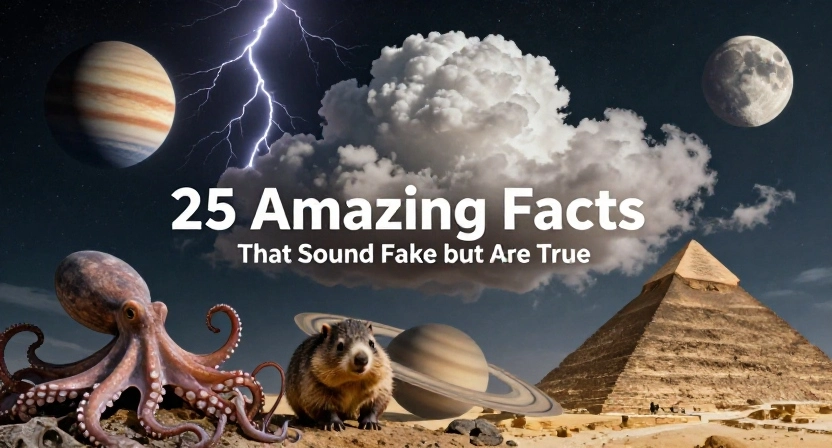
Saturn is enormous, but its average density is lower than that of water. In a completely hypothetical bathtub large enough to hold a planet, Saturn would therefore be less dense than the water around it and could float. NASA stresses that this is a density comparison, not a realistic experiment. Saturn is a gas giant without a normal solid surface, and the pressures inside it would destroy any conventional spacecraft long before you could perform such a stunt. (NASA Science)4. The Moon has earthquakes
They are called moonquakes, and Apollo astronauts helped scientists discover them by placing seismometers on the lunar surface. Some moonquakes are caused by Earth's gravity pulling on the Moon. Others occur because the Moon is slowly cooling and shrinking. NASA notes that certain shallow moonquakes can reach about magnitude 5.5 and last for more than 10 minutes. (NASA Science) So the Moon is not a completely silent, frozen rock. It is still geologically active in subtle ways.5. Water can exist as solid, liquid, and gas at the same time
Under a very specific combination of temperature and pressure, water reaches its "triple point." At that condition, ice, liquid water, and water vapor can coexist in equilibrium. For ordinary water, the triple-point temperature is 273.16 kelvin, or about 0.01°C, at a pressure of roughly 611.657 pascals. Laboratories can use specially designed triple-point cells to create and measure this unusual state. (NIST) It sounds like a physics trick, but it is a real and carefully defined property of matter.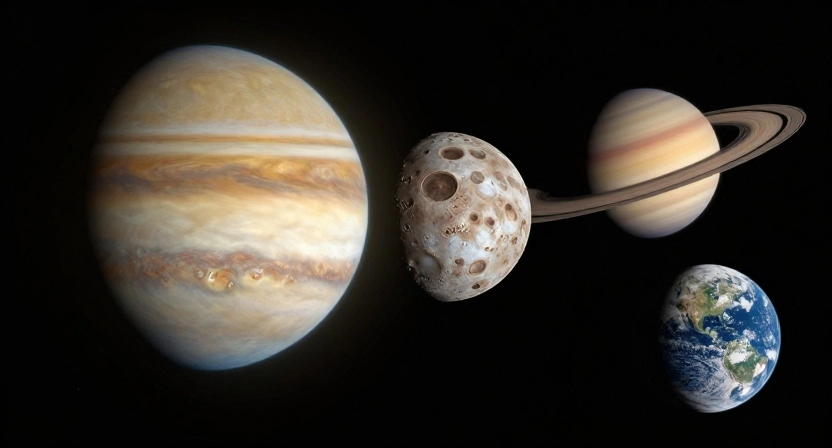
Earth Is Stranger Than It Looks
6. Lightning can be hotter than the surface of the Sun
A lightning channel can heat the surrounding air to around 54,000°F, or 30,000°C. That is roughly five times hotter than the Sun's visible surface, which is around 10,000°F. The rapid heating makes the air expand explosively, producing the shock wave we hear as thunder. (NOAA) The important distinction is that lightning is extremely hot but exists only briefly. It does not contain the enormous amount of energy stored in the Sun.7. A cloud can weigh more than 1 million pounds
Clouds look weightless because they float, but they are made from water droplets or ice crystals. The U.S. Geological Survey estimates that a typical 1-kilometer-cubic cumulus cloud can contain roughly 1.1 million pounds of water droplets. It stays aloft because the moist air associated with the cloud is less dense than the surrounding dry air, while rising air currents help keep the droplets suspended. (USGS) So the next time you look at a fluffy cloud, you are looking at an enormous amount of water distributed through a very large volume of air.8. Sound travels much faster underwater
Sound generally travels around 4,921 feet per second in seawater, compared with about 1,115 feet per second in air. The exact speed depends on temperature, pressure, salinity, and depth. These differences are one reason underwater acoustics are so important for marine animals, sonar systems, and ocean research. (National Ocean Service) This is also why comparing underwater sounds with sounds in air is not as simple as turning the volume up or down. The physical environment changes how the sound wave behaves.9. Earth's core is about as hot as the Sun's surface
This one needs a little precision. Earth's deep interior is extremely hot, with estimates for the inner core reaching several thousand degrees Celsius. NASA has described Earth's core temperature as roughly comparable to the temperature of the Sun's visible surface. (NASA) The difference is that the Sun's interior is vastly hotter than its surface. So saying "Earth's core is as hot as the Sun" would be misleading. Saying it can approach the temperature of the Sun's surface is the remarkable part.10. The world's largest desert is not the Sahara
The Sahara is the world's largest hot desert, but Antarctica is the largest desert overall. Deserts are defined primarily by extremely low precipitation, not by heat or sand. Antarctica receives very little precipitation across much of its enormous area, making it a polar desert. That changes the way we think about the word "desert." A place can be covered in ice and still qualify.Animals That Sound Like They Belong in Fiction
11. Sharks are older than trees
Sharks and their relatives have been swimming in Earth's oceans for roughly 450 million years. That puts their lineage far earlier than dinosaurs and even before trees appeared in their modern forms. The American Museum of Natural History describes shark relatives as having been around long before trees, dinosaurs, and humans. (American Museum of Natural History) Modern sharks are not unchanged prehistoric creatures, of course. They have evolved extensively. But their deep evolutionary history is genuinely ancient.12. Octopuses have three hearts and blue blood
Two of an octopus's hearts pump blood toward the gills. A third circulates oxygen-rich blood through the rest of the body. Their blood appears blue because they use a copper-containing protein called hemocyanin to transport oxygen rather than the iron-containing hemoglobin used by humans. The chemistry works particularly well in the cold, low-oxygen conditions where many octopuses live. (Smithsonian Magazine) Even stranger, the main systemic heart stops beating while the octopus swims, which helps explain why many octopuses prefer crawling.13. Wombats produce cube-shaped poop
This is one of those facts that sounds like an internet joke until you learn that Australian researchers have studied the phenomenon seriously. Wombat feces really are cube-shaped. Their digestive system gradually forms the material into cubes, which are useful for territorial marking because the pieces are less likely to roll away from where the wombat leaves them. (CSIRO) In other words, the strange shape is not random. It is connected to the animal's behavior and anatomy.14. Axolotls can regenerate entire limbs
The axolotl, a Mexican salamander, has an extraordinary ability to regenerate complex body structures. Adult axolotls can regenerate limbs, and researchers study the cellular process because it may help explain why humans have such limited regenerative abilities. Scientists are particularly interested in the "blastema," a collection of regeneration-competent cells that develops after an injury. (PubMed Central (PMC)) This does not mean humans are close to regrowing arms. It means the axolotl provides a valuable biological model for understanding regeneration.15. Tardigrades have survived exposure to space
Tardigrades, sometimes called water bears, are microscopic animals famous for their ability to enter extremely resistant states when conditions become hostile. In 2007, tardigrades were exposed to the space environment during a low-Earth-orbit mission and survived. NASA continues to study them to understand how biological systems tolerate extreme stress. (NASA Science) They are not indestructible, however. Their survival depends on specific physiological states and conditions. The real science is impressive enough without turning them into superheroes.16. Honey can remain edible for an extraordinarily long time
Honey has a combination of properties that make it unusually resistant to spoilage. It contains very little available water, is highly concentrated in sugar, and has chemistry that makes life difficult for many microorganisms. When kept sealed and protected from added moisture, honey can remain stable for extremely long periods. Crystallized honey is not necessarily spoiled. (Smithsonian Magazine) The important qualification is the seal. Honey is not magically immune to contamination, and moisture can change the situation.17. A banana is botanically a berry, but a strawberry is not
In everyday language, a berry is simply a small, juicy fruit. Botanically, the definition is much more specific. Under botanical classification, bananas qualify as berries because they develop from a single flower's ovary and fit the relevant fruit structure. Strawberries are different: the fleshy part people eat is not the botanical fruit itself. The tiny structures on the surface are the actual fruits. So your grocery-store definition of "berry" and a botanist's definition are very different things.18. Koalas have fingerprints that can resemble ours
Koalas have fingerprints with patterns that are surprisingly similar to human fingerprints. This is not evidence that koalas are closely related to humans. Fingerprints evolved independently as useful structures for gripping surfaces, and similar environmental pressures can produce similar solutions in unrelated animals. It is a nice example of convergent evolution: different species can arrive at remarkably similar biological designs.19. Sea otters sometimes hold hands while resting
Sea otters are known to hold onto one another while floating, particularly when resting in groups. The behavior can help prevent individuals from drifting apart. Sea otters also sometimes anchor themselves in kelp, creating a practical way to remain in place while they sleep. It is tempting to describe the behavior as purely affectionate, but scientists are cautious about assigning human emotions to animal behavior. The practical explanation is fascinating enough.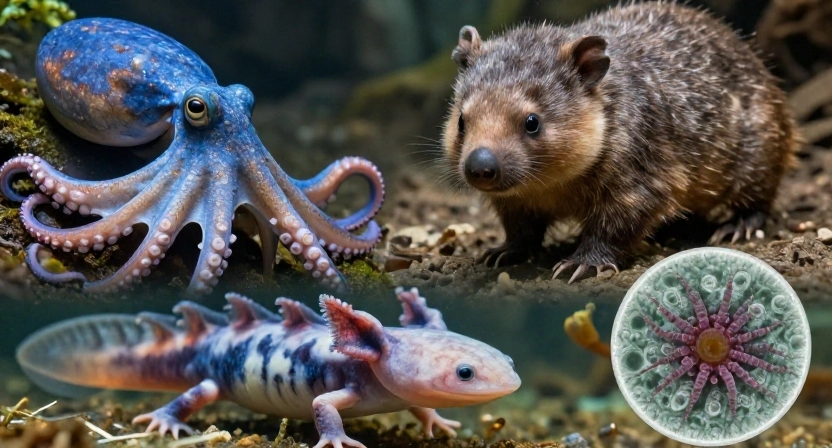
History and Geography Are Full of Time-Travel Moments
20. Oxford University is older than the Aztec Empire
There is evidence of teaching at Oxford as early as 1096. The Aztec Empire, by contrast, emerged in the 15th century. That means Oxford was already an established center of learning centuries before the Aztec Empire became a major power in Mesoamerica. Oxford describes itself as the oldest university in the English-speaking world, with nine centuries of continuous existence. (Oxford University) Putting unrelated timelines side by side can make history feel much less abstract.21. Cleopatra lived closer to the Moon landing than to the construction of the Great Pyramid
Cleopatra VII lived from 69 to 30 BCE. The Great Pyramid at Giza was constructed roughly 2,500 years before her lifetime, while the first human Moon landing occurred in 1969, less than 2,000 years after her death. The point is not that Cleopatra was "modern." She obviously was not. The comparison simply shows how enormous the span of ancient Egyptian history was. When Cleopatra ruled Egypt, the Great Pyramid was already an extremely ancient monument.22. Scotland's national animal is the unicorn
A mythical creature as a national animal sounds like something from a fantasy novel, but Scotland really does use the unicorn as its national animal. The choice has deep historical roots in Scottish symbolism. Medieval European traditions associated unicorns with strength, purity, and nobility, and the creature became part of Scottish royal imagery. So if you expected every national animal to be a real species, Scotland has an entertaining exception.23. Alaska is both the easternmost and westernmost U.S. state
This sounds geographically impossible until you look at the Aleutian Islands. The 180th meridian, which separates eastern and western longitudes, passes through Alaska's Aleutian chain. As a result, depending on how longitude is defined, Alaska contains both the easternmost and westernmost points in the United States. The State of Alaska specifically identifies Pochnoi Point and Amatignak Island in this context. (Alaska.gov) Alaska is therefore an excellent example of why maps and geography can behave differently from our intuitive idea of left and right.24. Petrified wood is actually stone
At places such as Petrified Forest National Park in Arizona, some objects that look remarkably like tree trunks are no longer wood in the ordinary sense. Ancient trees were buried under sediment and volcanic material. Mineral-rich groundwater then moved through the porous wood, with silica and other minerals gradually replacing or filling the original cellular structure. The result is stone that can preserve surprisingly detailed features of the original tree. (National Park Service) It is essentially a geological snapshot of a tree, preserved long after the original organic material disappeared.25. Earth's core is solid even though it is extremely hot
This sounds contradictory because we normally associate extreme heat with melting. Earth's inner core is primarily solid iron and nickel, despite its enormous temperature. The reason is pressure. At the center of Earth, pressure is so immense that it raises the temperature required for the material to melt. Surrounding the inner core is the liquid outer core, whose moving metallic material plays a major role in generating Earth's magnetic field. NASA describes the inner core as a solid iron-and-nickel sphere surrounded by a liquid outer core. (NASA Science) This is a good reminder that temperature alone does not determine whether something is solid or liquid. Pressure matters too.